The concept
The concept for the Park was developed in collaboration with the Sendzimir Foundation. The process involved broadly defined community consultations and workshops conducted using the participatory ‘charrette’ method (from the French, literally meaning ‘cart’ method). These events were attended by scientists, experts and representatives of the Capital City of Warsaw, as well as staff from the Copernicus Science Centre. Thanks to the involvement of various groups, a preliminary vision has been developed that takes into account the ideas and needs of all those who took part in the discussion.
We therefore hope that the implementation of the project’s main objectives – adapting to climate change and increasing biodiversity – will ensure that the Park also meets the needs of the capital’s residents, tourists, visitors and the Centre's staff, enabling them to explore nature and enjoy it through direct contact with it.
What will the park look like?
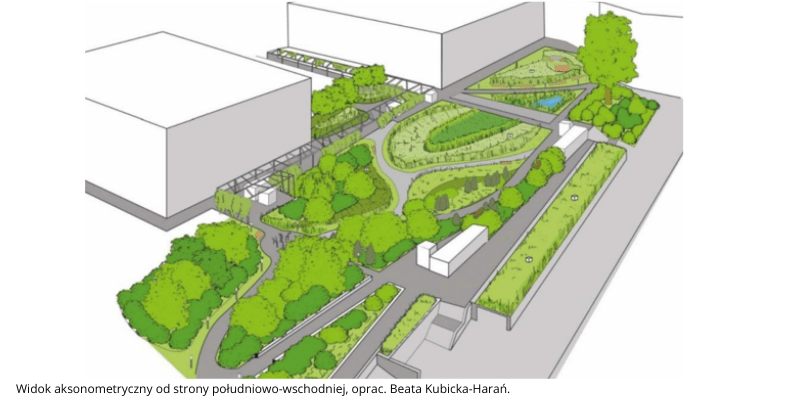
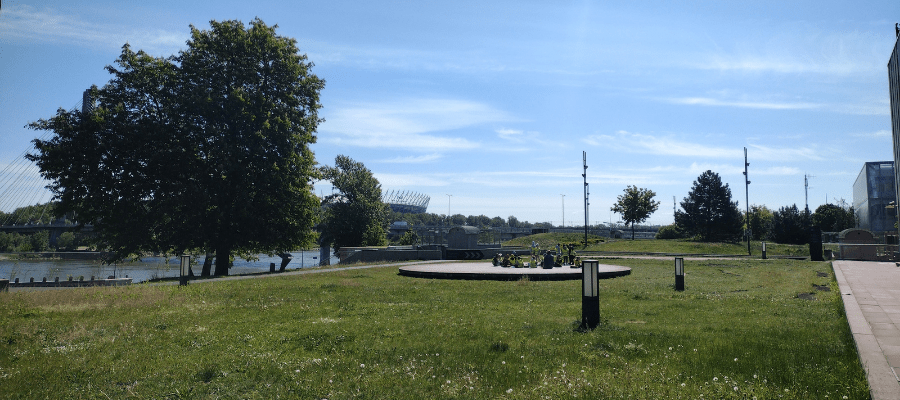
The Biodiversity Park will be designed to reflect the native landscape along the Vistula, which changes as the river flows. River sandbanks, inland dunes and hills will shape the landscape, which, sloping gently from south to north, will allow rainwater to collect at the northern end of the park, in a pond designed for this purpose.
The topography will take into account issues relating to water retention, the acoustics of the space (urban noise pollution) and views.
The park’s vegetation will consist exclusively of native species, and the placement of different types of plants will depend on local water conditions – some will be planted in sunny spots (e.g. shrubs, grasslands), whilst others will grow in flower meadows, reed beds and floodplains. The project's biocenotic nature assumes the creation of environmental conditions that are as close as possible to natural ones.
As a result, the park's habitats will provide both shelter and food for as many species of flora and fauna as possible. All maintenance work (including mowing and watering) will be kept to a minimum.
Blue-green infrastructure
The adaptation of cities to climate change is one of the key challenges of our time. We already have tools whose use seems obvious when designing green spaces. One of these is blue-green infrastructure, i.e. nature-based solutions ( NBS). In the Biodiversity Park, these will be two small water bodies which, together with the surrounding area, will serve as bioretention features.
Biodiversity
One of the project's most important objectives is to increase biodiversity within the future park. The concept of biodiversity is appearing more and more frequently in public discourse. We are witnessing what is known as the sixth mass extinction.
To slow down the rate of the Earth’s biological impoverishment, we are creating biodiversity enclaves – places which, thanks to special measures, have the potential to become sanctuaries for wildlife and thus, even on a small scale, contribute to the protection of species threatened with extinction, which are often crucial to the sustainable functioning of ecosystems.
The Biodiversity Park project aims to create a number of natural habitats specific to our local conditions. We plan to carry out in-depth studies to monitor biodiversity levels at every stage of the green enclave's development, starting with the current situation. This is extremely important for assessing actions, making adjustments to them and monitoring changes over time.
Environmental education
Field activities relating to environmental education will form an integral part of our park. It is here that a significant part of the educational activities will take place, including observing changes in the natural world, collecting research materials, carrying out research, conducting tests and experimenting. This will be facilitated by numerous monitoring stations, educational display boards and a specially designed meeting space – the ‘green classroom’.
Promotion of best practice
The Biodiversity Park will also serve as a venue for testing state-of-the-art solutions and best practices relating to environmental initiatives. This will enable us to promote tried-and-tested strategies and methods in the future and to help other institutions, schools and organisations to implement them.
Civic education
We will be running activities related to civic education in the park. Collecting soil or water samples, and taking part in BioBlitz walks (i.e. short, intensive field surveys) will be an excellent opportunity to engage the public in scientific activities, and thus an opportunity to forge closer ties with the natural world around us.
“The Biodiversity Park – adapting the area around the Copernicus Science Centre to climate change” (co-financed under the European Funds for Infrastructure, Climate and Environment Programme 2021–2027, Priority FENX.01: Support for the energy and environment sectors from the Cohesion Fund, co-financed from the Cohesion Fund, Measure: FENX.01.02 Adaptation of urban areas to climate change, Project type: Support for sustainable stormwater management systems incorporating greenery, green-blue infrastructure and nature-based solutions (NBS).
A project funded by the Ministry of Climate and Environment.
Source: https://www.kopernik.org.pl/park-bioroznorodnosci
Date of publication: 2020-09-07. Date of revision: 2026-07-26. awa
Realizator: Centrum Nauki Kopernik