
Przemiany Festival | October 2-4
Experimental stations

At the experimental stations, you will be able to test the programmes and apps for yourselves. You will find out how they work and what mechanisms are responsible for this.
Experimental stations programme
Programme of the Copernicus Science Centre Laboratories:
AI grammar, How does AI see you?, GO-playing robots, a conversation with NAO
3–4 October 🕖 12.00 pm – 7.00 pm
The Demagog Association’s programme:
Memory Real&AI, ‘Who said that?’
3–4 October 🕖 12.00 pm – 8.00 pm
Interactive workshops station:
Patterns of Memory: What are memories made of?
4 October 🕖 3.00 pm – 7.00 pm
Experimental stations at the exhibition
Programme of the Copernicus Science Centre Laboratories
3–4 October (Saturday–Sunday)
12.00 pm – 7.00 pm
Level +1
AI Grammar (Teachable Machine)
You will become trainers of a simple neural network. The Teachable Machine tool allows you to upload data – such as images – which the network uses to learn. You’ll see for yourselves how this data affects the performance of a simple model.
How does AI see you?
Can artificial intelligence find you in a crowd? You can find out by uploading your photo to the app. You'll see how much information AI needs to recognize you, how to trick it, and what emotions are detected from our faces.
A GO-playing robot
Play a game of GO against the KittyGO bot and watch how artificial intelligence makes decisions. On the screen opposite, you will see a visualisation of the board analysis process: possible moves, predicted scenarios and an assessment of the situation. This usually remains hidden within AI systems – the way in which machines ‘think’.
An interview with the NAO
What does artificial intelligence know about itself? Our NAO robot can talk about AI and its impact on our lives. See for yourselves whether a conversation with a machine is any different from one with a human, and decide for yourselves how much of artificial intelligence is down to technology and how much is down to our own imagination.
Relaxation and drawing exercises with Patrycja Maksylewicz
2 October (Friday)
8.30 pm – 11.00 pm
3 October (Saturday)
12.00 pm – 3.00 pm and 6.00 pm – 8.00 pm
4 October (Sunday)
12.00 pm – 3.00 pm and 4.00 pm – 7.00 pm
Close your eyes, relax and focus on your breathing. With the artist’s help, translate its rhythm into an intuitive drawing. At the same time, the sensor will record your breathing, and the algorithm will generate a graphical representation of it. Finally, you will compare the two images and see how a human’s and a machine’s interpretation of the same signal differ.
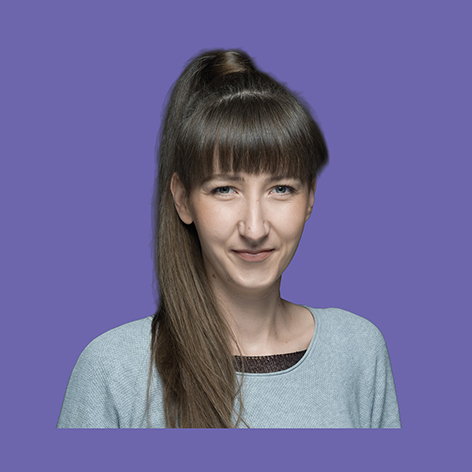
Patrycja Maksylewicz
Intermedia artist
Read full bio
Patrycja Maksylewicz is an intermedia artist. In her work, she focuses on interactive relationships, particularly those between humans and machines. She is interested in the concept of computational creativity and the analysis of biometric data through the language of art. She explores the relationships between different media and the ways in which they are used in both the real and virtual worlds – including in site-specific projects.
She has taken part in exhibitions, workshops and conferences both at home and abroad. Winner of the 2018 Krakow Art Salon competition in the ‘Initiative of the Year’ category. A graduate of the Faculty of Intermedia at the Jan Matejko Academy of Fine Arts in Kraków, where she currently holds the position of assistant professor. She is also associated with the Foundation for the Development of Intermedia Art.
The Demagog Association’s Programme
3–4 October (Saturday–Sunday)
12.00 pm – 8.00 pm
Level +1
Memory Real&AI
It’s a game in which a set of pictures consists of images depicting the same thing. One of them is real, and the other was generated by AI. Can you tell which one it is? As you play, you’ll also learn about methods and tools for identifying AI-generated content.
“Who said that?”
Through your headphones, you will hear statements from public figures. Can you tell which of these have been generated by AI? Check it out! Once you’ve completed the quiz, you’ll be able to distinguish genuine recordings more accurately.
Patterns of Memory: what are memories made of?
Interactive workshop station
4 October (Sunday)
3.00 pm – 7.00 pm
Lecture Room, Level 0
“Patterns of Memory” is an intergenerational workshop combining traditional textile techniques, personal memories, research into language and memory, and artificial intelligence.
You will create your own ‘memory patterns’ – visual representations of important places, people and experiences – and then use them as a starting point for autobiographical stories. With the participants’ consent, the narratives will also form part of research into how language reflects memory and cognitive processes. The analysis of narratives is one of the areas of research into healthy ageing and the changes associated with neurodegenerative diseases.
Bielik’s Polish language model will help us examine the language and themes of the stories and identify the motifs that link the stories of different people. In this way, an experimental archive of memory will be created, in which technology helps to preserve people’s stories without replacing the people who tell them.
Researchers, project authors:

Dominika Cecylia Wnuk
Researcher and lecturer, computer scientist and linguist
Read full bio
Dominika Cecylia Wnuk is a researcher and lecturer at the Polish-Japanese Academy of Information Technology; she is a computer scientist and linguist by training. She seeks out places where technology meets what is deeply human: the voice, language, memory and the experience of ageing.
As part of her PhD research, she is investigating whether changes in the voice can aid in the early diagnosis of neurodegenerative diseases. She is a member of the European COST Action eVoiceNet network, which focuses on vocal biomarkers, and previously worked as an NLP engineer.
She is interested not only in what can be measured, but also in how data can tell stories about people. She is particularly drawn to projects that combine science, art and technology, whilst also creating a space where different generations and different perspectives on memory can come together.

Katarzyna Kowalczyk
Graphic designer and design researcher
Read full bio
Katarzyna Kowalczyk is a graphic designer and a PhD student at the ICT & Design Doctoral School of the Polish-Japanese Academy of Information Technology. In her design and research work, she is interested in how images, patterns, books and stories can give a voice to people and experiences that are rarely represented in visual culture.
Her PhD project, ‘One Ludowe’, she focuses on women’s textile and handicraft practices in Poland: embroidery, weaving, ornaments, domestic archives and histories passed down by women. Through field research, interviews and visual documentation, she seeks ways to translate these stories into a contemporary visual language.
She is particularly drawn to projects that combine design, memory, heritage and important social issues – especially those that create a space for histories that have hitherto been overlooked and undervalued.